
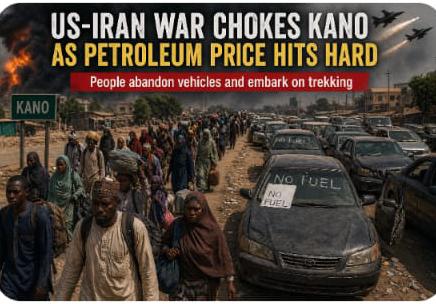
Since February 28, 2026, when the US and Israel launched an attack on the Islamic Republic of Iran, motorists in Kano, a city far away from the Middle East are bearing the brunt, as they groan under prohibitive fuel prices.
The war which was started by the two allied countries was one of the world’s deadliest military campaign ever since the Gulf War of the 90s.
Our correspondents report that as the war escalated in the Middle East, motorists in Kano are paying the price as they groan under prohibitive fuel prices.
Named “Operation Epic Fury,” the 38-day joint military campaign was allegedly said to have degraded Iran’s military, nuclear, and missile infrastructure and had earlier resulted in the death of Iran’s Supreme Leader Ali Khamenei along with several other key Iranian figures.
While it lasted,the offensive focused on dismantling Iran’s missile and drone capabilities, destroying the Iranian navy, and targeting its defense industrial base.
The war in its 38-day joint military campaign war codenamed “Operation Epic Fury,” allegedly focussed on degrading Iran’s military, nuclear, and missile infrastructure, which had earlier resulted in the death of Iran’s Supreme Leader Ali Khamenei and several other key figures.
While it lasted, the offensive focused on dismantling Iran’s missile and drone capabilities, destroying the Iranian navy, and targeting its defense industrial base.
The two allied countries commenced the conflict unmindful of its global economic implications, particularly as it would disrupt oil supplies and cause energy crisis and resultant high prices of goods and services.
As the war escalated,oil prices surged with a barrel of crude oil selling above $100 in the global energy market, forcing the pump price of petrol to also rise across the world.
The trend manifested in Nigeria when our major petrol supplier, the Dangote Refinery increased the gantry price of petrol, citing the hike in the prices of crude oil in the global market.
Thus, petrol marketers whom have allegedly been waiting for such opportunity, immediately adjusted their fuel pump metres to now begin to sell at far above N1,000 per litre from the previous less than N1,000 per litre, which immediately destabilized the socio-economic lives of the people.
In Kano, the hustles and bustles of the commercial city began to wane with most motorists, especially private car owners, taking their vehicles off the streets because of their inability to fuel them at prohibitive rates.
Our investigation around the ancient city revealed that the situation has compelled most private vehicles owners to park them and resort to patronizing public transport to reach their various destinations.
And many of them have bought motorcycles and bicycles, while some resorted to trekking to satisfy their transport needs.
Thus, the major streets of the state capital such as Ibrahim Taiwo Road, BUK Road, Sabo Bakin Zuwo Road, Audu Bako Way and Zaria Road are largely populated by tricycles popularly known as “A Daidaita Sahu”, which are the main public transport vehicles in the state.
It was also observed that due to the situation, the filling stations are largely deserted with few vehicles now seen purchasing fuel at between N1,305 and N1,320 per litre, while the service station attendants are beckoning on motorists to come and patronize them.
A chat with some of the distressed motorists was quite revealing as it was pathetic.They explained that they took away their vehicles from the roads because they could no longer afford to fuel them due to the cut-throat prices of petrol.
One of them, Abubakar Isiyaku, who does business at the Abubakar Rimi market, Sabon Gari, Kano, said he now goes to the market on commercial tricycle, having parked off his private car because of his inability to fuel it.
“I resorted to the measure having realized that I could no longer afford N10,000 to purchase just 7.5 litres of fuel for my car, every other day, when I have competing needs to attend to, including feeding and medication.
“I now trek halfway to the market and board ‘Dan Sahu’ to complete the journey and use the same measure to return home, spending a total of N300 daily, which is by far cheeper than using my car,” Isiyaku said.
Another motorist, Baba Shayabo, described the fuel price hike as “debilitating,” saying that the situation had compelled him to stop taking his children to school in his private car,and that he is now forcing the youngsters to be boarding ‘Dan Sahu’ to reach their school.
“Before the fuel price increase, I was using my car to transport my children to school, but the petrol price hike has forced me to park the car. I now give the children some money to enter ‘Dan Sahu’ to reach their school. Some times, I ask them to trek part of the distance. Thank God, they are on holiday now,” Shayabo said.
It is a more drastic measure for Mallam Sani Zubairu, a public servant, who sold off his car and bought a motorcycle so as to reduce the cost of fuel needed for his daily movements.
“I sold off my fairly old car and bought a motorcycle, which is more economical for me in terms of fuelling. I used to fuel the car at N1,320 per litre, and with say N10,000, I would only get about 7.6 litres, which would last me for about three days. I found this very unrealistic.
“But now, I spend about N5,000 to purchase three litres of fuel for my motorcycle, and this will last me for about a week. This is more feasible and affordable,” Zubairu added.
The situation has prompted a national conversation on the need for the Compressed Natural Gas (CNG) as an alternative fuel for vehicles. The CNG was introduced by the Bola Tinubu administration to ease the prevailing high cost of fueling and transportation in the country.
To benefit from the initiative, however, motorists must first visit the CNG conversion centre to have their vehicles’ engines converted to CNG machines which reportedly costs hundreds of thousands of Naira per engine.
Thus, the discussion centres around two key issues: affordability of the engine conversion and the safety of the initiative.
The conversation points out that while the engine conversion enables the vehicle owners to use cheaper fuel (CNG) to satisfy their transport needs, accessing the service itself is an economic challenge as most of them are overwhelmed by other compelling needs.
The discussion also posits that motorists and commuters alike have been expressing fears about the safety of the initiative which entails installing a gas cylinder in a car boot, directly under the back seat and not too far away from the exhaust pipe.
The discussants cited a recent incident of a CNG-powered luxury bus exploding at a Kaduna motor park, to buttress their point.
The US-Iran war has subsided following a fragile agreement reached between the two warring nations. And in response to the temporary respite, crude oil prices dropped to somewhere below $100, but tension is still high in the war zone, especially around the embattled Straight of Hormuz.
The Dangote Refinery has further slashed its gantry price of petrol, but filling stations especially those in Kano have not significantly effected any price adjustment, thus dashing any hope that the situation will improve.
And the palpable implication of this is that the vehicles parked due to the continued inability of their owners to fuel them, may begin to develop system decay, especially in their engines and tyres.
Checks Naija report that while the war persisted in the Middle East, the effect has affected the living standard of the people in Kano in view of the rising prices of petroleum products.