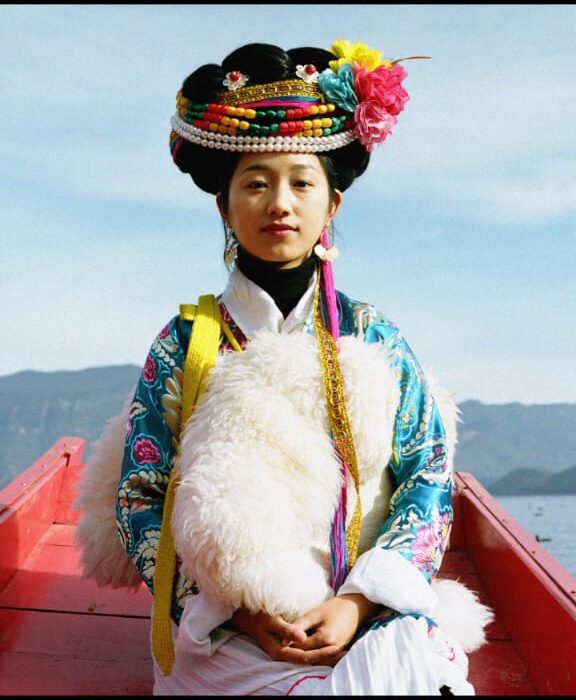

The Mosuo people are a small ethnic community living mainly around Lugu Lake on the border of Yunnan and Sichuan provinces in southwestern China. They are famous worldwide for their matrilineal society.
Origins and Early History
The Mosuo are believed to be part of the larger Naxi ethnic family, with roots going back over 2,000 years. Their ancestors likely migrated from the Tibetan Plateau into the Lugu Lake region, settling in the mountains where isolation helped preserve their unique culture.
Ancient Chinese records from the Tang and Song dynasties mention tribes in this region that scholars link to the Mosuo.
Matrilineal Society
One of the most distinctive features of Mosuo history is their matrilineal system:
Family lineage follows the mother’s line.
Property is inherited by daughters.
Children belong to the mother’s household.
The maternal uncle often plays the main male role in raising children.
Women traditionally head households and manage economic affairs.
“Walking Marriage” Tradition
Historically, Mosuo practiced a custom known as “walking marriage” (tisese):
Couples do not live together permanently.
Men visit women at night and return to their mother’s home in the morning.
There is no formal wedding or cohabitation requirement.
Children stay with the mother’s family.
This system reduced divorce conflicts and kept family property stable.
Religion and Beliefs
Traditionally, the Mosuo followed:
Daba religion (an indigenous belief system)
Later influenced by Tibetan Buddhism
Their beliefs emphasize nature spirits, ancestors, and harmony with the environment.
Mosuo Under Imperial and Modern China
Imperial China
Because of their remote location, the Mosuo remained largely autonomous, paying limited tribute but keeping their customs..
Mosuo Community: Where ” Walking Marriage Exist “